Project · FounderBnbalyze
A vibe-coding experiment that became a full proptech SaaS.
Built independently, adopted by 100+ organic users, tested with real-estate pilots — and now being rebuilt with AI at its core.
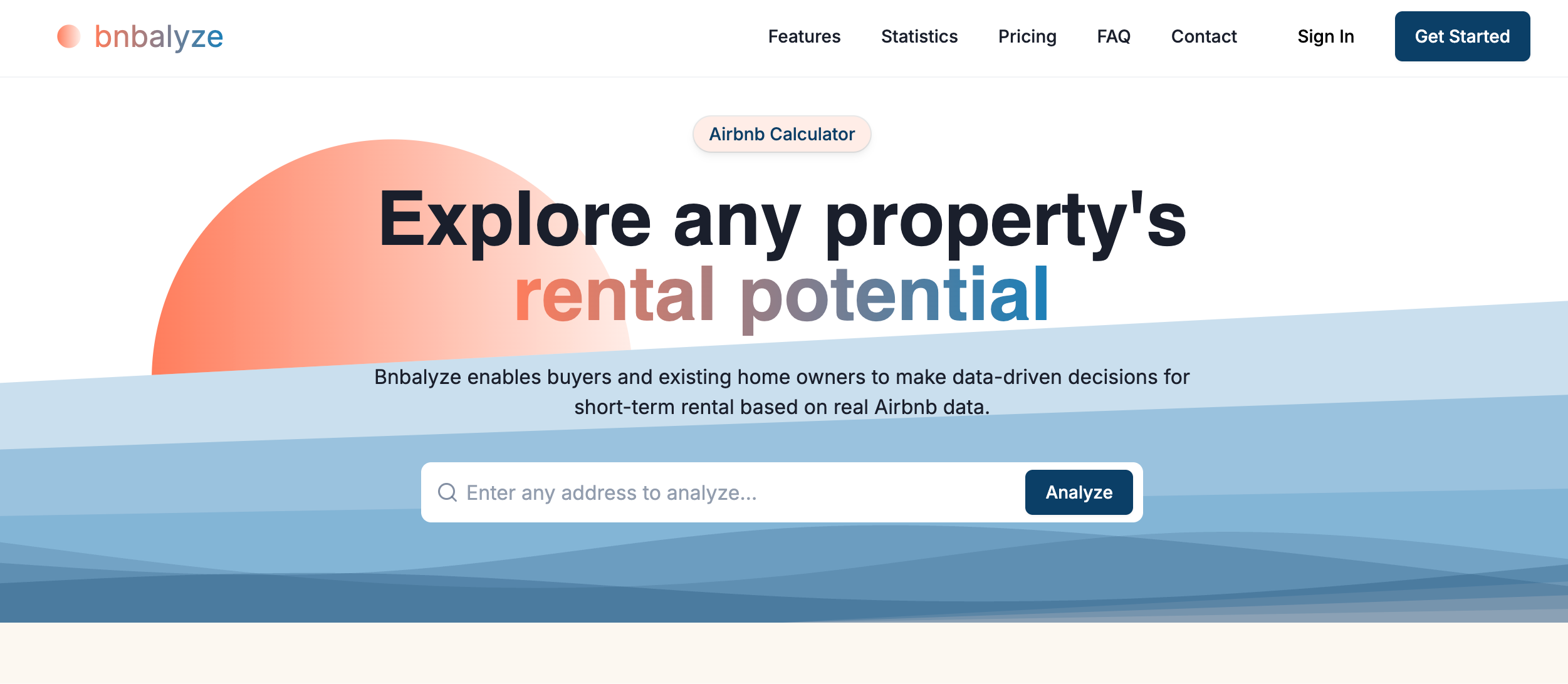
A vibe-coding test that turned into a product.
Bnbalyze began as a personal experiment: I wanted to see how far I could take an idea through vibe coding with Lovable. The initial concept was a simple calculator for evaluating the short-term-rental potential of a property.
It quickly grew into a full SaaS platform — user accounts, market-data integrations, comparable-property maps, interactive financial modelling, subscriptions, downloadable reports, analytics, an internal CRM and admin tooling. I conceived, designed, built and operated the entire product independently.
Bnbalyze moved beyond a technical experiment. I onboarded real-estate professionals as pilot customers and attracted more than 100 self-serve users organically, without a paid-acquisition campaign. The original product was later paused — and I am now building Bnbalyze 2.0: a ground-up, AI-native rebuild combining deterministic financial calculations with visual property analysis, autonomous area research, official market statistics and regulatory risk assessment.
The starting point
Property analysis is fragmented and slow.
Evaluating a property as an investment means stitching sources together by hand. Buyers typically need to combine:
- Property listings
- Short-term-rental platforms
- Mortgage calculators
- Local market information
- Regulatory research
- Spreadsheets
Act I
From experiment to SaaS platform
Built independently with Lovable, React, TypeScript and Supabase.
From address to report
The journey was straightforward — search an address → confirm the property → add financing → analyze the market → explore scenarios → download a report. A single search returned a full investment analysis, with assumptions kept editable through interactive maps, charts, tables and sliders, and a completed analysis downloadable as a professional PDF:
- Average daily rate, occupancy and estimated rental revenue
- Nearby comparable short-term rentals
- Purchase, mortgage and operating costs
- Annual profit and cash-on-cash return
- Investment score and estimated payback period
- Ten-year rental-growth and property-appreciation scenarios
The platform behind the calculator
What began as an interface experiment grew into a complete SaaS architecture. Supabase handled the database, auth, backend functions, caching and access controls; Google Maps and Places powered address search and comparables; Airbtics, AirDNA and Apify supplied rental-market intelligence; Stripe handled subscriptions and usage limits. On top of that I built:
- A custom auth and user-management flow
- A normalized data layer between external APIs and the product
- Market-data caching to control cost and improve performance
- Interactive mortgage, ROI and payback calculations
- Custom PDF report generation
- An internal CRM, product analytics and GA4
- Slack operational notifications and admin tooling
- A marketing site and blog CMS
- Row-level security and protected backend functions
One stable internal format
A particularly important decision was to translate every external API response into one stable internal format. That abstraction let me migrate the Airbtics integration from its old API setup to the public API without rebuilding the analysis interface or the report system.
Act II
Real-world validation
Moving from a technical experiment to something people could find, understand and use.
Real-estate pilot customers
Once the platform was functional, I onboarded real-estate professionals as pilot customers — giving agents a data-driven way to communicate a property’s rental and investment potential, support conversations with investment-minded buyers, and share a report after a viewing. Their feedback showed which figures buyers cared about first, what made the analysis feel credible, how much detail an agent needed, and where the product could support the existing sales process. The agents contributed feedback and context; all product strategy, design, development and integrations remained entirely mine.
UX research with Hyper Island
I also ran a collaboration with UX students from Hyper Island to challenge my assumptions through structured research — user interviews, journey mapping, usability testing, prototype evaluation and hypothesis testing. The central challenge was communicating complex financial and market information without overwhelming the user. The findings sharpened the information hierarchy, the customer journey and the relationship between high-level recommendations and detailed data — and I translated the research into product decisions and implemented them myself.
100+ organic users
Alongside the pilots, Bnbalyze attracted more than 100 self-serve users organically — people who discovered, understood and used the platform without a paid campaign or manual onboarding. For a project that began as a vibe-coding experiment, that organic adoption was meaningful evidence the problem and product resonated beyond my initial assumptions.
Act III
Rebuilding with AI at its core
Not an AI assistant bolted onto the calculator — a ground-up rebuild with AI inside the analysis pipeline itself.
The pause, and a sharper question
I paused active development when other priorities took over, and the distance clarified the strongest opportunity. v1 was good at calculating an investment from market data and inputs — but it couldn’t understand a property’s actual condition, research the area itself, or judge whether short-term-rental regulation undermined the case. The central question for 2.0 became: how do you build an AI-driven property analysis reliable enough to inform an investment decision? My answer was to keep facts and judgement strictly separate. An LLM should never guess a price, calculate a mortgage or invent a return — but it’s excellent at interpreting images, researching an area, spotting contextual risks and explaining a complex case.
Structured listing ingestion
A user submits an Idealista or Hemnet listing URL, and a Next.js / TypeScript pipeline runs several stages in parallel. Apify and residential proxies extract the asking price, floor area, coordinates, attributes and images directly from the listing — the portals use anti-bot protection, so reliable ingestion needed dedicated infrastructure. An LLM never reads or guesses these figures.
Visual property analysis
Claude Opus inspects room-labelled photos and assesses the property’s actual condition. In testing it flagged a virtual-staging render that didn’t represent the real room and recognized a dated 1990s kitchen — producing a realistic €35,000–€65,000 renovation range instead of a generic €3,000–€9,000 estimate.
Autonomous area research
A web-research agent investigates schools, transport, amenities and planned developments. On a real Seville listing it returned 22 sources, identified 11 schools by name and uncovered a €400 million urban-regeneration project — none of which the user had to research manually.
Official price statistics
Spanish house-price data is retrieved deterministically from the national statistics institute (INE). Quarterly index data and year-over-year movements are computed in code, not estimated by an LLM.
A regulatory gate
Short-term-rental feasibility is classified RED, AMBER or GREEN — and the regulatory result appears before the projected returns, so a legal obstacle can’t be overlooked just because the yield looks attractive.
A deterministic financial model
Mortgage math, break-even and ten-year projections are implemented and unit-tested in TypeScript; the LLM never touches these numbers. It writes a grounded investment memo only after the calculations are complete, and the memo is validated against the underlying figures to prevent invented financial claims.
Engineering reliable AI workflows
LLM calls don’t always return the expected structure. I designed the pipeline so one imperfect response degrades a single section rather than crashing the analysis — tolerant schema validation, isolated error handling and fallbacks at every stage. Model routing sends expensive vision work to a stronger model while research, structuring and memo generation use a cheaper one, lowering cost per analysis without compromising quality where it matters most.
Where it stands now
The core 2.0 pipeline is proven end-to-end on real listings — structured ingestion, visual analysis, area research, official statistics, regulatory assessment and deterministic modelling working together, with the financial model under automated test coverage. Next:
- Full support for Swedish Hemnet listings
- Swedish market statistics through SCB
- A user-selected mode for buying a home vs. evaluating an investment
Results
What the experiment proved.
From a personal vibe-coding test to a product people could find, understand and use on their own.
Organic self-serve adoption
More than 100 users discovered and tried the platform without a paid-acquisition campaign or manual onboarding — evidence the problem and product resonated beyond my initial assumptions.
Validated with real-estate pros
I onboarded agents as pilot customers, giving them a data-driven way to communicate a property’s rental and investment potential — and a report they could share after a viewing or meeting.
Idea to full SaaS, independently
Product strategy, UX, architecture, frontend and backend, integrations, security, analytics and commercial development — every part owned and built by one person.
Now an AI-native rebuild
A ground-up rebuild is proven end-to-end on real listings, evolving the product from a rental calculator into an agentic property analyst that separates verified facts from machine judgement.
“What started as a vibe-coding experiment became a complete proptech SaaS with real-estate pilots and more than 100 organic users — and is now evolving into an AI-native property analyst built around a clear separation between verified facts and machine-generated judgement.”
Tech stack
Ownership
Conceived, built and validated — solo.
Bnbalyze was conceived, designed, built, integrated, operated and validated entirely by me:
- Product strategy
- Vibe-coding workflow
- UX
- Architecture
- Frontend & backend development
- Financial modelling
- Integrations
- Security
- Analytics
- Pilot recruitment
- External research coordination
- Commercial development
Have an idea worth testing?
From a vibe-coded prototype to an AI-native product, let’s talk about building something real — fast, and without blurring facts and judgement.
Book a call →